
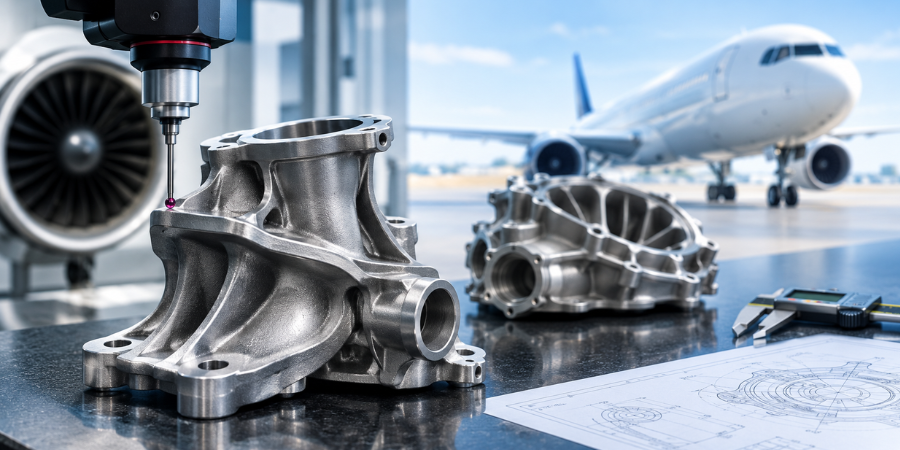
The aerospace industry requires total accuracy because it protects operational safety, system performance, and equipment reliability. Aerospace Parts Casting Manufacturers focus on producing components that meet precise manufacturing limits while withstanding extreme operational conditions. Investment casting for Aerospace manufacturers now prefers as their primary production method because it enables them to create complex products which require minimal machining through highly accurate and repeatable production processes. The advanced casting process enables the production of turbine blades and structural brackets to achieve lightweight design and material efficiency while maintaining high quality standards which meet the precise tolerance requirements of current aerospace systems.
Understanding Aerospace Tolerance Requirements
The aerospace industry requires its components to fulfill extremely precise dimensional and geometric requirements which protect their safety and aerodynamic performance and their ability to function over time. The investment castings used in aerospace applications have been designed to meet these essential performance standards which apply to crucial operational environments.
- The acceptable range for dimensional tolerances extends between ±0.1 mm and more precise measurements.
- The standard requires specific geometric tolerances for flatness and concentricity and profile accuracy.
- The surface finish standards exist to decrease friction while increasing resistance to fatigue.
Why Aerospace Parts Casting Manufacturers Use Investment Casting
Aerospace investment castings of production parts achieve their precise manufacturing requirements through their dual ability to create intricate designs while using materials in an efficient manner that no other production technique can replicate.
- Secondary machining is decreased because of near-net-shape capability.
- The system can produce objects with both complex internal passages and thin wall structures.
- The process ensures consistent production results for essential components at a high level of accuracy.
Common Aerospace Components Made Using Investment Castings
The aerospace industry uses investment castings to create complex components which require high precision and strong materials and lightweight design. The process allows manufacturers to produce complex shapes which conventional machining methods cannot achieve without significant expense.
- Components that include turbine blades and vanes must endure both extreme temperatures and rotational forces.
- Engine housings and casings require engineers to maintain precise control over their dimensional specifications.
- Airframes and assembly structures use structural brackets and fittings for their components.
- Nozzles and impellers and flow-control components feature internal passages with intricate designs.
- Aerospace fasteners and connectors require designers to create products that maintain high strength while keeping their weight low.
Materials Used in Investment Castings for Aerospace
The selection of materials in aerospace investment castings needs to meet requirements because components must withstand extreme temperature and stress and corrosive conditions. Different materials get selected for aerospace applications based on their specific performance needs.
Nickel-based superalloys: Ideal for turbine blades, vanes and engine components which operate under conditions of elevated temperatures and thermal cycling.
Stainless steels: Deliver exceptional corrosion protection together with strong structural integrity to both structural components and housing systems.
Titanium alloys: Provide an exceptional strength-to-weight ratio which makes them ideal for use in airframe structures and high-performance aircraft components.
Aluminum alloys: Serve as the material of choice for making lightweight components which require moderate strength and resistance to corrosion.
Precision Tooling and Wax Pattern Accuracy
The foundation of dimensional control in investment castings for aerospace applications relies on precise tooling and wax patterns.
- The use of high-precision dies results in reduced dimensional variation between products.
- The controlled parameters of wax injection create a stable production process for manufacturing operations.
- The inspection process for patterns prevents subsequent steps from experiencing tolerance problems.
Advanced Shell Building and Ceramic Mold Control
The shell-building method and ceramic mold control process in aerospace investment castings serve as key factors which produce accurate measurements and exceptional surface quality. The ceramic mold serves as the complete negative replica of the finished product because its measurement accuracy determines the casting’s allowable range of variation and resistance to defects.
Controlled shell thickness: The process creates equal strength distribution which stops metal from changing shape during both pouring and solidification.
Ceramic material selection: The process requires selection of high-quality refractory materials which control thermal expansion and provide protection against cracking.
Layer-by-layer monitoring: The team applies and dries each layer of ceramic material which results in stable measurements.
Temperature management: The use of appropriate heating and drying processes creates lower stress levels which result in fewer defects including warping and surface flaws.
Process Control Techniques for Tight Tolerances
The aerospace industry needs precise measurements for its investment castings which require complete process management throughout their production process. The main techniques used for this purpose consist of:
Controlled Pouring Temperature: Exact temperature control of molten metal prevents weight loss during solidification while maintaining consistent movement of the liquid metal.
Optimized Pouring Rate: Controlled metal flow operations decrease turbulence while they also reduce the occurrence of internal defects.
Solidification Management: The combination of appropriate cooling methods with directional solidification techniques leads to reduced distortion and internal stress development.
Statistical Process Control (SPC): The system achieves process consistency by monitoring vital process parameters which helps the system maintain its required accuracy standards.
Automation and Sensors: The system uses real-time feedback to identify incorrect casting conditions which enables operators to make necessary adjustments.
Post-Casting Operations to Meet Aerospace Tolerances
The aerospace industry requires investment castings to undergo post-casting procedures after precision casting because these procedures enable the achievement of exact dimensional specifications and perfect surface finish requirements. The aerospace industry needs these procedures because they help aerospace applications achieve their precise tolerance requirements.
CNC Machining: This process removes extra material while it creates precise measurements of essential components.
Heat Treatment: This process eliminates remaining internal stresses while it increases the material’s ability to withstand stress and its overall strength.
Grinding and Polishing: This process enhances surface appearance while it guarantees surface texture meets aerodynamic and operational requirements.
Straightening and Stress Relief: This process corrects minor distortions that occur during solidification and handling processes.
Deburring and Finishing: This process makes aerospace components suitable for quality standards by removing all sharp points and visible defects from their surfaces.
Inspection and Quality Assurance in Aerospace Investment Castings
The accurate investment castings produced by Aerospace Parts Casting Manufacturers need to undergo a complete inspection process to validate their precision before approval.
- The inspection process uses Coordinate Measuring Machines CMM for its measurements.
- The process uses X-ray and CT scanning and other NDT methods for its inspection.
- The verification process examines both dimensional specifications and metallurgical properties of the object.
Certifications and Standards for Aerospace Investment Castings
Aerospace suppliers must execute their investment casting operations according to international standards which serve as obligatory requirements for their business.
- AS9100 quality management certification
- NADCAP process accreditation
- ASTM and customer-specific aerospace standards
Challenges in Meeting Ultra-Tight Tolerances
The present state of investment casting technology in aerospace applications faces ongoing challenges despite its advanced technical capabilities.
- The two factors which cause metal shrinkage problems together with thermal distortion
- The process of tolerances which arise from complex geometric shapes
- The process of maintaining uniformity throughout extensive manufacturing runs.
Future Trends in Investment Castings for Aerospace
Ongoing research work produces new advancements which improve the precision of tolerance control used in aerospace investment castings.
- The combination of digital simulation methods with predictive modeling techniques
- The combination of automation technology with artificial intelligence creates optimized process control systems
- The manufacturing process combines traditional techniques with advanced additive manufacturing methods through hybrid production systems.
Conclusion
The process of investment casting for aerospace creates essential components which require high-precision manufacturing and complex design. The castings use advanced materials and controlled processing methods together with their comprehensive quality assessment system to produce reliable aerospace applications which perform with high efficiency. Manufacturers utilize post-casting processes and inspection methods together with their global standard compliance system to achieve exact measurement standards as well as complete mechanical and surface finish testing of all components. Investment castings serve as essential components for current aviation systems and advanced aerospace engineering projects.
FAQs
What tolerance levels can investment castings achieve for aerospace components?
The investment castings demonstrate the ability to create exacting tolerances which reach beyond the critical component threshold of ±0.1 millimeters.
Why are investment castings preferred over machining for complex aerospace parts?
The method creates complex shapes which produce products that require little extra work while using less raw material than standard machining techniques.
Which aerospace materials work best with investment casting processes?
Aerospace applications require the use of nickel-based superalloys together with titanium alloys and stainless steel and aluminum alloy materials.
How is dimensional accuracy verified in aerospace investment castings?
The system uses CMM inspection together with X-ray and CT scanning methods to perform non-destructive testing which ensures measurement accuracy.
What certifications should an aerospace investment casting manufacturer have?
The AS9100 standard and NADCAP certification together with ASTM compliance and customer-specific approvals provide the necessary quality and traceability standards.